
Review the key concepts, formulae, and examples before starting your quiz.
🔑Concepts
Voltaic (Galvanic) cells convert chemical energy from spontaneous redox reactions into electrical energy. In these cells, the anode is the negative electrode (site of oxidation) and the cathode is the positive electrode (site of reduction). Electrons flow from the anode to the cathode through an external circuit, while ions migrate through a salt bridge to maintain charge neutrality.
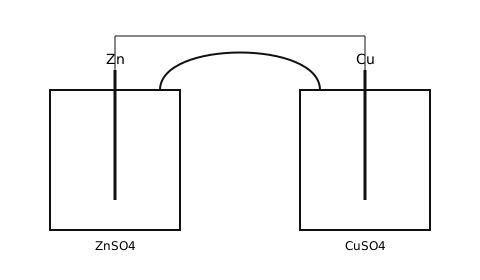
Electrolytic cells use an external source of electrical energy to drive non-spontaneous redox reactions. The anode is the positive electrode where oxidation occurs, and the cathode is the negative electrode where reduction occurs. For aqueous solutions, the products depend on the relative values of the species present and the concentration of the electrolyte.
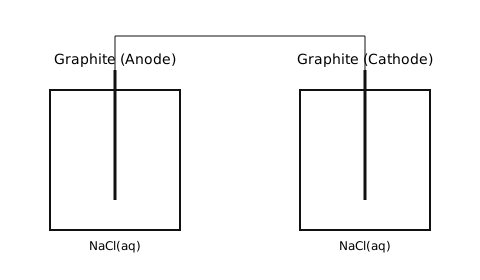
The Standard Hydrogen Electrode (SHE) serves as the reference point for measuring standard electrode potentials (), assigned a value of . Potentials measured against the SHE indicate the tendency of a species to be reduced; more positive values represent stronger oxidizing agents.
Gibbs Free Energy change () is related to the cell potential by the equation . For a reaction to be spontaneous, must be positive, which results in a negative .
📐Formulae
💡Examples
Problem 1:
Calculate the standard cell potential () for a voltaic cell based on the following half-reactions: () and (). Determine if the reaction is spontaneous.
Solution:
- Identify the cathode and anode: The more positive value is the cathode (), and the more negative value is the anode ().
- Use the formula: .
- Since , the reaction is spontaneous.
Explanation:
In a voltaic cell, electrons flow from the species with the more negative electrode potential (reducing agent) to the species with the more positive electrode potential (oxidizing agent). The positive cell potential confirms a negative Gibbs free energy change.
Problem 2:
Predict the products formed at the electrodes during the electrolysis of molten sodium chloride ().
Solution:
At the Negative Electrode (Cathode): At the Positive Electrode (Anode):
Explanation:
In molten salts, only the constituent ions are present. Sodium ions are reduced to sodium metal at the cathode, and chloride ions are oxidized to chlorine gas at the anode.
Problem 3:
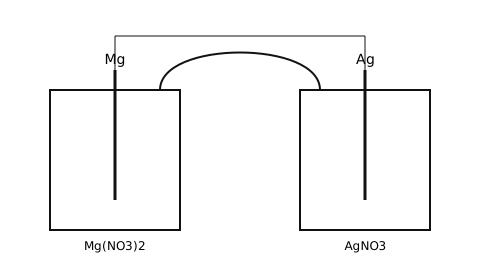
Determine the cell notation and calculate the standard cell potential for a voltaic cell composed of a Magnesium half-cell () and a Silver half-cell (). Given: and .
Solution:
- Identify anode and cathode: has the more negative potential, so it is oxidized (Anode). has the more positive potential, so it is reduced (Cathode).
- Cell Notation:
- Calculation:
Explanation:
Since the cell potential is positive (), the reaction is spontaneous. Magnesium acts as the reducing agent, and Silver ions act as the oxidizing agent.
Problem 4:
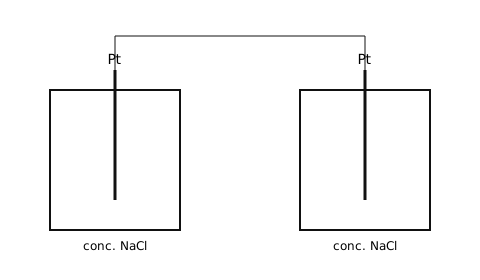
In the electrolysis of concentrated aqueous sodium chloride using inert electrodes, identify the half-equations for the reactions occurring at each electrode and state the observations.
Solution:
- At the Cathode (Negative): . Hydrogen gas is evolved because is more easily reduced than .
- At the Anode (Positive): . Chlorine gas is evolved because of the high concentration of chloride ions (overpotential effect).
- Overall observation: Bubbles of colorless gas at the cathode and pale green gas at the anode. The remaining solution becomes basic due to formation.
Explanation:
Selective discharge occurs based on the relative electrode potentials and the concentration of the ions in the electrolyte. In concentrated , is discharged despite values suggesting oxygen might form.